
Back

VIVID 9i 3D Laser Scanner

VIVID 9i provides high precision, making it well suited for the dimensional measurement demands of industrial processes such as dies, casting, forging, sheet metal and molded plastics part production.
Request a Quote

The VIVID 9i uses a new hardware design and an improved measurement algorithm to provide 4x the measurement accuracy than that of our previous models (to 50µm), enabling 3D measurement of automobile parts and other objects formed by casting, pressing, molding, etc.

The VIVID 9i can be used for reverse engineering to reflect the shape and dimension data of mock-ups or prototypes in design drawings, or for checking part shape, checking molds, inspecting quality, etc. in prototype-production or mass-production processes.

Share
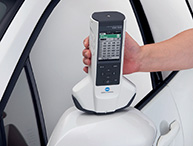
Image of VIVID 9i 3D Laser Scanner – Highly accurate 3 D Shape Measuring Instrument

High speed, high precision, and measurement accuracy of ±50µm

The VIVID 9i requires only 2.5 seconds per scan to acquire accurate 3D data. This means that the VIVID 9i is ideal for accuracy verification and shape inspection of cast, forged, and pressed automotive parts and plastic-molded automotive parts.

Measure targets of any size

Konica Minolta has employed its expertise in optical engineering to develop interchangeable, high-performance, dedicated lenses. As a result, TELE, MIDDLE and WIDE lenses can be selected to accommodate the size of the measurement target.

(Input range in X, Y and Z directions: 93 × 69 × 26 mm to 1495 × 1121 × 1750 mm)

Point & Shoot, Leave detailed settings to the 9i

Konica Minolta’s AF/AE technology, developed through its expertise in camera manufacturing, relieves users from the need to determine the exact measuring distance. Moreover, the system automatically determines the optimum laser power for the surface conditions of the target.

(Scan Range: standard mode 0.6 to 1.0 m, Extended mode 0.5 to 2.5 m )

High speed and high accuracy

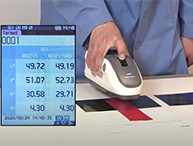
Start the measurement by framing the scan area on the LCD Viewfinder of the VIVID 9i unit or on the host computer’s display. Each scan requires only 2.5 seconds for acquiring accurate 3D data.

Standards-Traceable performance

Konica Minolta supports compliance with ISO 9000. Manufacturers using VIVID 9i for QC applications can receive a test report of the accuracy of each 9i, traceable to national standard. This ensures that our measuring instruments and your process conform to ISO 9000 requirements.

* On request, Konica Minolta can provide a test report for each 9i unit. This test report is created by evaluating the measurement accuracy for all 3 lenses of each 9i using our Reference 3D Chart, an artifact traceable to national standards, and thus can be used as documentation for conformance with ISO requirements.

Give us your part, and we’ll prove it to you.

The new Field Calibration System maintains the high-reliability of the factory settings by canceling the degraded accuracy caused by lens exchange or a change in environment. A simple calibration procedure before use assures the optimal performance from the 9i.

Share
Type
3D Laser Scanner
Measuring Method
Triangulation light block method
Light-Receiving Lenses (Interchangeable)
TELE Focal distance f=25 mm
MIDDLE Focal distance f=14 mm
WIDE Focal distance f=8 mm
Scan Range
0.6 to 1.0 m (In Standard mode)
0.5 to 2.5 m (In Extended mode)
Laser Scan Method
Galvanometer-driven rotating mirror
Laser Class
Class 2 (IEC60825-1), Class 1 (FDA)
X Direction Input Range (In Extended mode)
TELE 93 to 463 mm
MIDDLE 165 to 823 mm
WIDE 299 to 1495 mm
Y Direction Input Range (In Extended mode)
TELE 69 to 347 mm
MIDDLE 124 to 618 mm
WIDE 224 to 1121 mm
Z Direction Input Range (In Extended mode)
TELE 26 to 680 mm
MIDDLE 42 to 1100 mm
WIDE 66 to 1750 mm
Accuracy (X,Y,Z)
±0.05 mm (Using TELE lens at distance of 0.6 m, with Field Calibration System, Konica Minolta’s standard, at 20°C)
Precision (Z, σ )
0.008 mm (Using TELE lens at distance of 0.6 m, Konica Minolta’s standard, at 20°C)
Input Time (per scan)
2.5 sec
Transfer Time to Host Computer
Approx. 1.5 sec
Ambient Lighting Condition
Office environment, 500 lx or less
Imaging Element
3D data: 1/3-inch frame transfer CCD (340,000 pixels)
Color data: Common with 3D data (color separation by rotary filter)
Number of Output Pixels
3D data/Color data: 640 x 460
Output Format
3D data: Konica Minolta format, & (STL,DXF, OBJ, ASCII points, VRML)
(Converted to 3D data by the Polygon Editing Software/ standard accessory)
Color data: RGB 24-bit raster scan data
Data File Size
Total 3D and color data capacity: 3.6MB per data
Viewfinder
5.7-inch LCD (320 × 240 pixels)
Output Interface
SCSI II (DMA synchronous transfer)
Power
Commercial AC power, 100 to 240 V (50/60Hz), rated current 0.6 A (at 100 VAC)
Dimensions
221 (W) × 412 (H) × 282 (D) mm
Weight
Approx. 15 kg (with lens attached)
Operating temperature/humidity range
10°C to 40°C, relative humidity 65% or less with no condensation
Storage temperature/humidity range
0°C to 40°C, relative humidity 85% or less (at 35°C) with no condensation
Regulatory approvals
UL 61010A-1, CSA-C22.2 No.1010-1, etc.

No accessories for this product.

Catalog Download: Download

Owner's Manual: Download

Case Studies:

Carolina Bronze: Making Giant Strides From Small Models
Carolina solved their challenging project with a turnkey system from Konica Minolta Sensing Americas. Their project required them to create a larger than life-size bronze statue of a Ronald Reagan, President. They were given an artist's mock up of the sculpture that was in pieces.
How were they going to scale the model up to 10 feet, how could they make it and what hardware, software and machines would they need? These were some of the problems facing Carolina Bronze.