

Color Control in Chemical Manufacturing: Why Visual Inspection Is No Longer Enough
Color is often one of the first indicators of product quality. Whether you’re producing resins, coatings, adhesives, lubricants, or specialty chemicals, even a subtle variation can raise concerns about formulation consistency and process control.
The challenge is that many manufacturers still rely heavily on visual inspection. While the human eye is excellent at detecting differences, it isn’t always a reliable method for making consistent quality decisions. Lighting conditions, observer perception, and visual fatigue can all influence how a product is evaluated. What looks acceptable to one operator may be rejected by another.
As customer expectations and quality standards continue to rise, manufacturers need a more objective approach to color control
The Cost of Color Inconsistency
Color variation can create significant problems throughout the manufacturing process. Raw materials may vary from supplier to supplier, production conditions can fluctuate, and products can change appearance over time due to heat, UV exposure, or oxidation.
The result can be:
- Rejected batches
- Increased rework
- Production delays
- Customer complaints
- Higher quality assurance costs
Even when a product performs as expected, appearance differences can affect customer confidence and brand perception.
Moving Beyond Visual Evaluation
This is where spectrophotometers play a critical role. Instead of relying on subjective assessments, a spectrophotometer captures precise color data that can be measured against established standards and tolerances. The result is repeatable, traceable color evaluation regardless of who performs the measurement or where it takes place.
Objective color measurement helps manufacturers:
- Improve batch-to-batch consistency
- Verify incoming raw materials
- Detect process drift early
- Standardize quality control procedures
- Reduce waste and rework
- Improve communication across multiple facilities
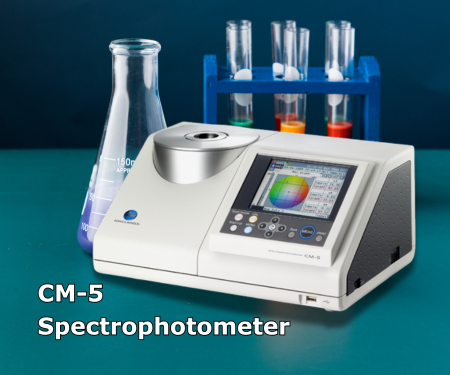
Meet the CM-5 Spectrophotometer
The Konica Minolta CM-5 Spectrophotometer is designed to meet the diverse measurement needs of chemical and material manufacturers. Unlike many instruments that focus on a single measurement method, the CM-5 performs both reflectance and transmittance measurements, allowing it to evaluate a wide variety of sample types with one instrument.
From liquids and powders to pellets, films, sheets, and opaque materials, the CM-5 offers the flexibility needed in modern laboratories and manufacturing environments. Its user-friendly design also makes it ideal for routine quality control, incoming material inspection, and production support applications.
Designed for Chemical Industry Applications
Chemical manufacturers often rely on specialized color scales to evaluate product quality. The CM-5 supports widely recognized industry standards, including:
- APHA Color Scale for near-colorless to pale-yellow liquids such as solvents and specialty chemicals.
- Gardner Color Scale for resins, varnishes, oils, and coating raw materials.
- Iodine Color Number for evaluating lightly colored oils, resins, and plasticizers.
These measurements help manufacturers monitor product purity, detect contamination, and maintain consistency from batch to batch.
A Smarter Approach to Quality Control
Color measurement is valuable at every stage of production. Incoming material inspections help verify supplier consistency before manufacturing begins. In-process measurements can identify issues before they become expensive problems, while final product testing confirms compliance with customer specifications.
Just as importantly, objective color data provides a solid foundation for investigating customer complaints and resolving disputes quickly and confidently.
Turn Color into a Competitive Advantage
In today’s manufacturing environment, visual inspection alone is no longer enough. Companies that implement objective color measurement gain better process control, improved product consistency, reduced waste, and greater confidence in their quality programs.
With the ability to measure both liquids and solids while supporting key industry color scales, the Konica Minolta CM-5 helps chemical and materials manufacturers transform color from a potential quality risk into a measurable competitive advantage.